Geysers at El Tatio, in Chile. Photo by Chmouel Boudjnah.
Work in the Chilean desert by Arizona State University scientists has reopened debate regarding the biological origins of Martian silica fragments found in 2007 — and strengthened the case for life on Mars billions of years ago.
NASA’s Spirit rover churned up the opaline silica deposits as it explored the Columbia Hills area of Mars’s Gusev Crater.
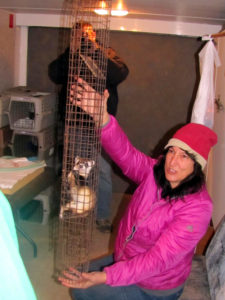
Wildlife specialist Jennifer Cordova holds a human trap containing the black-footed ferret captured by my group. Photo by Nicholas Gerbis.
For 11 years, volunteer citizen scientists have gathered near Seligman, Arizona, to help spot, capture and release endangered black-footed ferrets. The outing is part of a program to monitor captive-bred ferrets that wildlife specialists began reintroducing to Aubrey Valley 20 years ago.
Watson on Jeopardy stage set at the Computer History Museum in Mountain View, California. Photo by Atomic Taco.
Barrow Neurological Institute is working with IBM’s Jeopardy-winning supercomputer, Watson, to identify treatment targets for Lou Gehrig’s disease, also known as amyotrophic lateral sclerosis, or ALS.
ALS is a poorly understood neuromuscular disease with only limited treatment options. Its capacity to strike anyone, at any time, seemingly without pattern, has puzzled researchers.
New findings by the Translational Genomics Research Institute, or TGen, point to a surprising pattern in the brain cancer glioblastoma multiforme (GBM), the most common and deadly type of gliomas.
GBMs are aggressive, invasive and so genetically and structurally complex that advanced, targeted therapies have struggled to find vulnerabilities to attack.
Diagram of a mitochondrion, courtesy of Arizona State University.
Long before they develop neurofibrillary tangles or beta-amyloid plaques, brains with Alzheimer’s disease begin experiencing problems in their cells’ power plants — the mitochondria — that hinder their ability to make energy for cells.
Declines in gene expression related to mitochondria can occur in subjects as young as their early 30s.